
The Hidden Microcosm
How Bacteria Survive on a Leaf That Looks Dry
See how microscopic droplets and bacterial clusters can protect leaf residents, and why survival percentages and fluorescent sugar reporters need careful reading.
YouTube channel
Look closely at the living systems in a drop of water, a patch of moss, or a handful of soil.
A drop of pond water or a thin layer of moss can hold predators, grazers, and whole communities too small to notice unaided. The Hidden Microcosm will follow those organisms at their own scale: how they move, feed, sense their surroundings, and fit into a larger ecosystem.
The channel uses close views and scientific reconstructions to make these systems visible. An illustration can show a process clearly, but it is not a microscope image or direct evidence of every detail.
Videos and articles
Each page includes the original video, a short answer, key points, chapters, and sources.
See how microscopic droplets and bacterial clusters can protect leaf residents, and why survival percentages and fluorescent sugar reporters need careful reading.
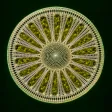
How diatoms assemble patterned silica in water, inherit rigid wall halves and restore cell size, with experiments that separate construction from protection.
A dry tun can withstand conditions that kill an active tardigrade. Compare heat experiments, protective proteins and what space survival actually establishes.
Inside a lichen, photosynthetic partners feed a fungal body. Water, light protection, and a changing carbon budget explain survival on exposed rock.
Follow nitrogen from microbial cells to ammonium, with evidence from nematode experiments and clear limits on what a soil food-web explanation can show.
How Demodex mites live in hair follicles, what DNA surveys really measure, and why reduced genes and tiny muscles reveal a life tied to human skin.
Trace two food routes through pond water: algae to grazers, and organic matter through bacteria to larger cells. Learn what the evidence can actually show.
Follow how bacteria build magnetosome chains, align with a field, and respond to oxygen. Mineral construction and chemical guidance do different jobs.
See how Stentor switches responses and changes with repeated stimulation, while separating species, molecular hypotheses, cellular memory, and consciousness.
Explore how Drechslerella dactyloides prepares a three-cell ring, expands its membrane, and traps nematodes, with the limits of sensor and crop-protection studies.
Living rotifers emerged from ancient frozen soil and reproduced. Separate the sediment date, contamination evidence, and clues to freezing tolerance.
A bacterial predator enters the space between its prey’s membranes, remodels the cell wall, and releases offspring only after feeding inside.
Lacrymaria olor stores its long neck in spiraling membrane folds. See how unfolding, cilia, and contraction let one cell search far beyond its body.


