Short answer
The answer in plain English
A blockchain can form part of a company's official stock ledger when the issuer and its transfer agent integrate the network into the legally recognized ownership record. A token's label is not enough: the system must connect wallets to holders, enforce transfer rules, preserve records, and define controls for errors, outages, and recovery.
Why it matters
What to understand
The SEC's September 2026 proposal would modernize transfer-agent rules for electronic and blockchain-based records, but it does not approve every tokenized stock or require issuers to use a blockchain. The decisive question is whether the network participates in the master securityholder file—the authoritative ownership record—or merely sends instructions to a separate register. Issuer-sponsored shares, custodial wrappers, and synthetic exposure can look similar in a wallet while giving holders very different rights.
Visual guide
How the pieces fit together


A token can be part of the register—but the label proves nothing
A blockchain can serve as part of a company’s official ownership record. The difficult part is not minting a token or placing a stock ticker in a wallet. It is making the network part of the legally recognized system that connects an issuer, its transfer agent, the registered holder, and every valid change in ownership.
That distinction is at the center of the SEC’s September 1, 2026 proposal to modernize federal transfer-agent rules. The proposal explicitly addresses electronic and blockchain-based recordkeeping. It does not require companies to issue shares on a blockchain, and it is not a general approval of products marketed as tokenized stocks. As of publication, it remains a proposed rule subject to public comment and possible revision.
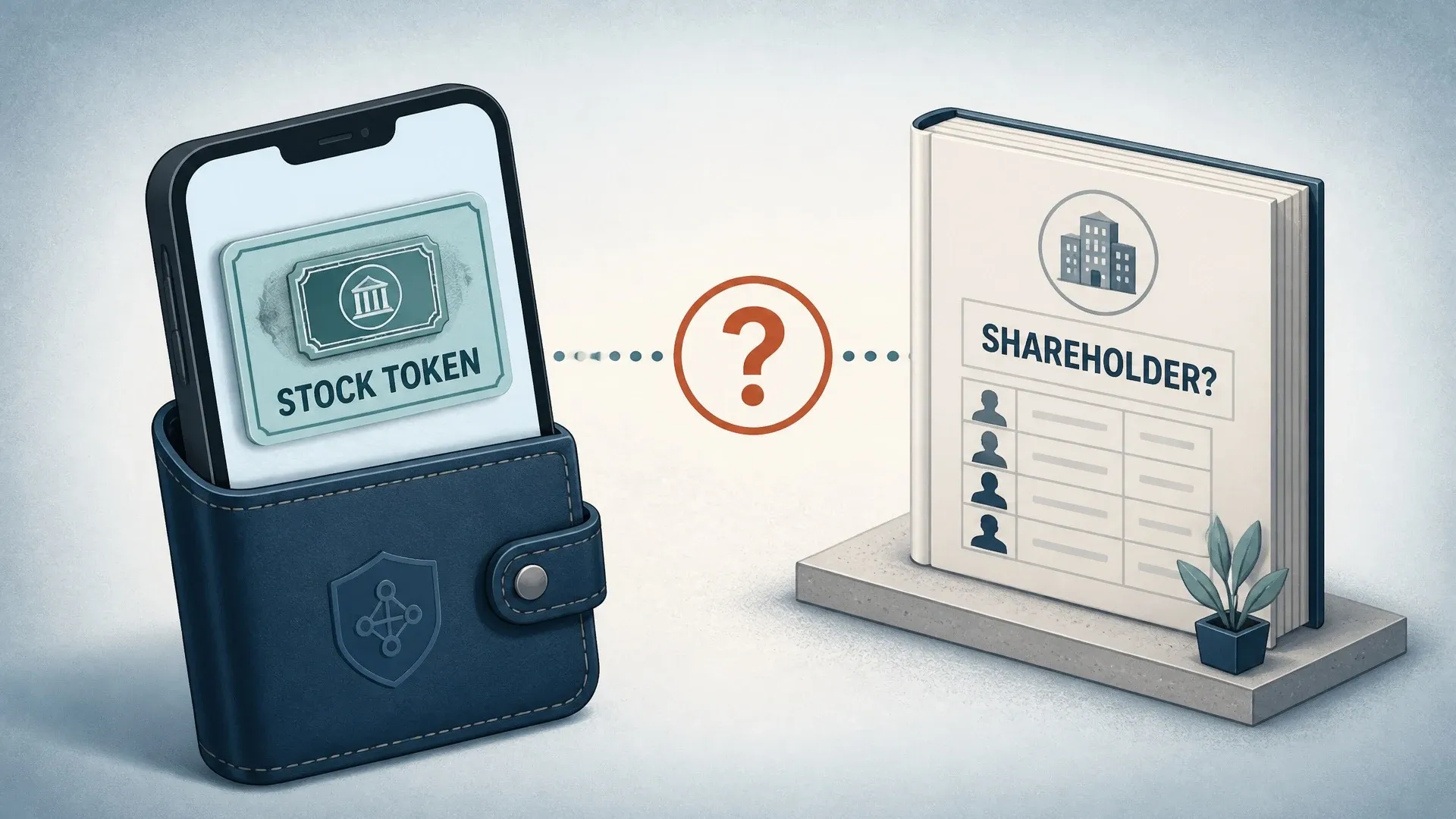
A blockchain can prove that a wallet controls a token, but the issuer’s recognized ownership record determines whether that token is the share itself.
The ordinary institution behind the technical question
Transfer agents maintain the official record of an issuer’s registered owners and process changes when securities are issued, canceled, or transferred. They also perform practical work such as distributing dividends, processing certain payments, and handling shareholder communications. The SEC calls the core ownership record the master securityholder file.
Most brokerage customers do not appear by name on that file. They usually hold as beneficial owners through an intermediary chain, while a nominee such as Cede & Co. appears as the registered holder. Direct registration works differently: the investor’s own name appears on the issuer’s books, even when there is no paper certificate.
Blockchain does not eliminate this distinction. It gives the recordkeeping system another technical design. The legal and operational question remains: which record is authoritative when systems disagree?
Two ways to connect a blockchain to ownership
In one design, the issuer or its transfer agent incorporates a blockchain into the master securityholder file. Wallet addresses and balances can sit onchain, while names, addresses, and compliance information remain offchain. An accepted transfer on the network then changes the recognized holding because the network is part of the official register.
In another design, the blockchain is not authoritative. A token transfer acts as an instruction or notification telling a separate database to update. If the onchain record and offchain register diverge, the offchain master file still governs. The interface may look similar to the investor, but the system’s source of truth is different.
The SEC staff’s January statement on tokenized securities describes both structures. It also makes a broader point: putting a security into tokenized form does not remove the federal securities laws that apply to its offer, sale, and transfer.
What an onchain share transfer still has to check
Imagine that Maya wants to transfer ten directly registered, blockchain-integrated shares to Jordan. Her wallet signs an instruction with her private key. That signature shows authorization from her address; it does not identify Jordan, establish that the transfer is lawful, or prove that payment occurred.
A functioning ownership system may need to confirm that Maya owns enough shares, Jordan’s address belongs to an eligible holder, and no restriction blocks the transfer. The transfer agent must connect the onchain addresses to reliable offchain identity records. Only after those checks pass does the accepted transaction update the recognized share balance.
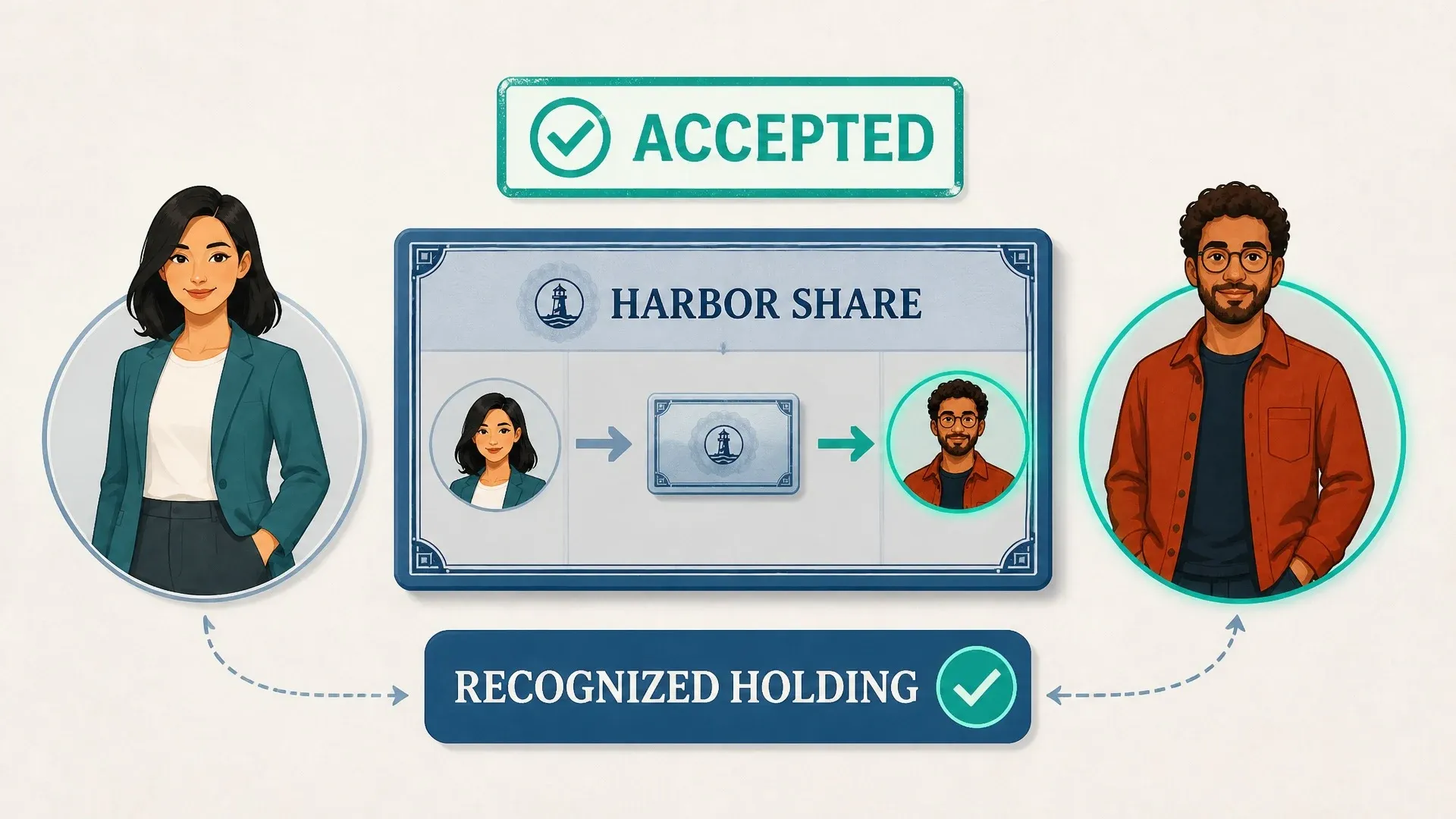
In an integrated system, a valid onchain transfer can update the issuer’s authoritative record after identity and transfer restrictions have been checked.
This is more than a technical nicety. A wallet can send a transaction while an identity database is unavailable. A holder can enter the wrong approved address. A network can remain online while the agent cannot complete a required check. The system therefore needs clear rules for correction, dispute handling, lost keys, record recovery, software changes, and business continuity.
Payment is a separate leg. Moving the share token does not prove that the seller received cash. A complete market workflow must coordinate the asset and payment, which is why delivery-versus-payment matters. Our explanation of DTCC’s live tokenized-securities transactions shows how institutions are testing that coordination inside controlled market infrastructure.
Direct shares, wrappers, and synthetic exposure are not interchangeable
An issuer-sponsored token can be the security itself when the issuer’s authorized recordkeeping system recognizes it. A third-party custodial token is different: an intermediary may hold conventional shares and issue a token representing a claim or entitlement connected to them. The underlying shares can remain in custody when the token changes wallets.
A synthetic product can go further and track a stock’s economic performance without giving the holder ownership of the referenced shares. Voting, distributions, redemption, and insolvency rights depend on the product’s documents and counterparties—not the ticker shown on screen.
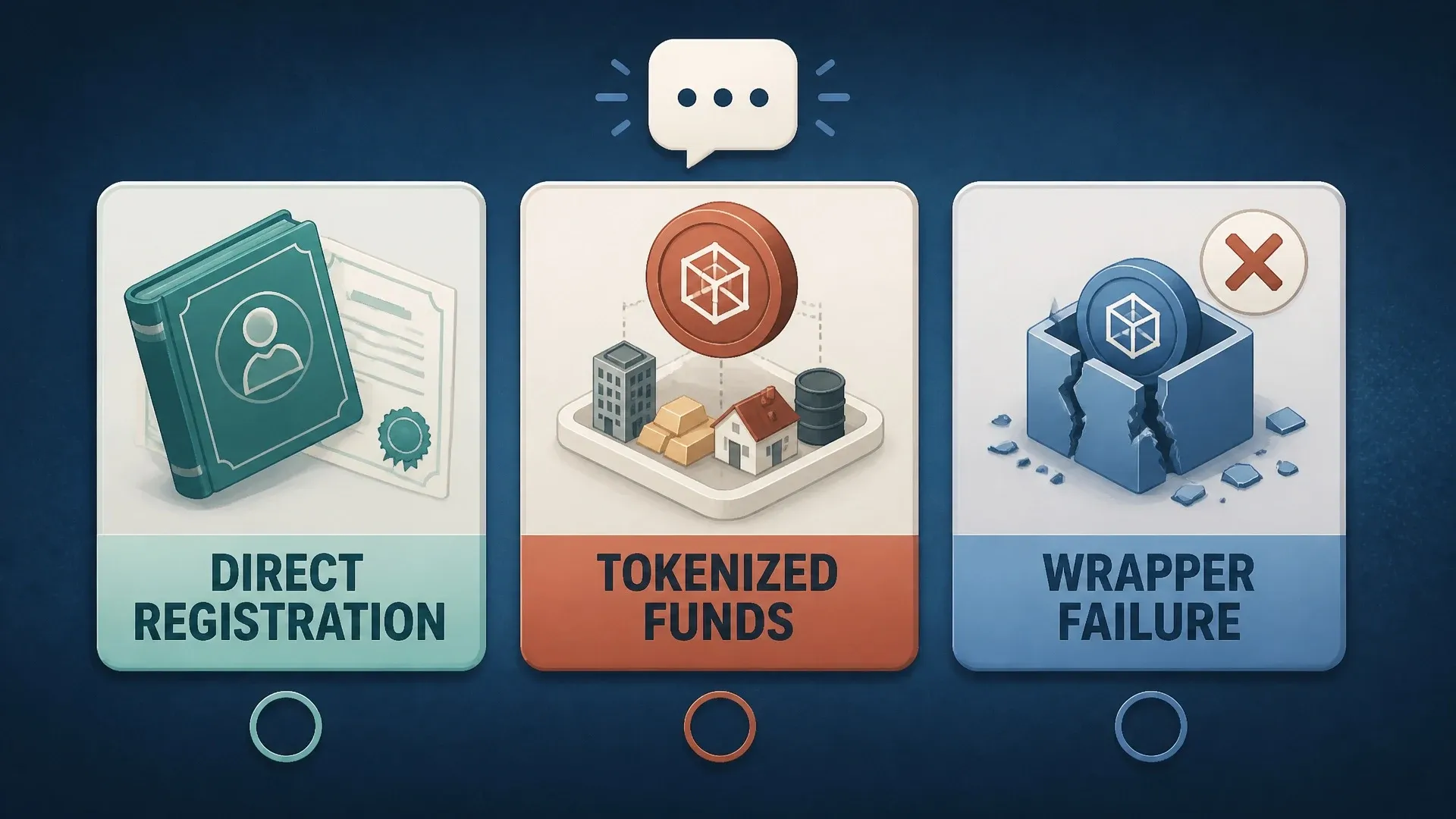
Similar-looking tokens can represent direct ownership, an interest in a pooled vehicle, or a claim against an intermediary with its own failure risk.
The practical test is concrete: if the platform or token issuer disappeared tomorrow, what could the holder claim, against whom, and under which records? Our broader guide to what tokenized-stock holders actually own applies that question to the main product structures.
What the SEC proposal would modernize
The proposal reaches beyond blockchain terminology. It would update registration and annual reporting, electronic recordkeeping, turnaround standards, risk management, inactive-holder procedures, compliance programs, and rules for restrictive legends. Its fact sheet describes a broader safeguarding framework covering securities and funds in an agent’s possession, control, or custody, plus a separate bank account for certain funds and a business continuity plan.
Those requirements show why an immutable transaction history is not a complete operating model. Someone must remain accountable for protecting assets, maintaining accurate records, responding to failures, and deciding how valid corrections occur. The proposal also asks for comment on some issues, including aspects of cyber-incident reporting. A question in a proposing release is not a rule already in force.
Integration may matter as much as the ledger
A blockchain-integrated register could reduce reconciliation between a token movement and the official ownership update. Yet investors still need access to brokers, trading venues, payment systems, and existing settlement infrastructure.
In a July 2026 letter, Computershare argued that issuer-sponsored tokens should connect efficiently with DTC infrastructure. Its concern was that poor connectivity could split liquidity into separate pools and make it cumbersome to move between directly registered holdings and the market where most trading occurs. That is an industry participant’s position, not a guaranteed result, but it identifies a real design constraint.
The useful question is therefore not whether a blockchain can store a list. It plainly can. The test is whether the ownership record, legal rights, identity layer, transfer restrictions, payment process, recovery controls, and surrounding market infrastructure agree on what that list means. When they do, a blockchain can participate in the official stock ledger. When they do not, a token may be only a parallel record—or a claim against somebody else.

