Short answer
The answer in plain English
Geckos stick to glass with millions of microscopic, branching hairs on their toe pads. Their flattened tips approach the surface closely enough for weak van der Waals attractions to add up. A small pull aligns and loads the hairs for grip; curling the toe changes their angle and peels the contacts apart in sequence.
Why it matters
What to understand
Gecko feet are dry, reusable contact systems rather than suction cups or glue pads. Rows of lamellae support microscopic setae, which branch into nanometer-scale spatulae. This hierarchy conforms to a surface and creates enough intimate contact for molecular attraction to matter. Directional loading switches the grip on, while rolling the toe away concentrates detachment along a moving edge. Dust, water, roughness, humidity, and surface chemistry can still change performance.
Visual guide
How the pieces fit together


A dry foot can still be adhesive
A gecko on a window looks as if it should need either glue or suction. Its toes are broad, the glass is smooth, and gravity is pulling the animal away from the surface. Yet the pads stay dry and can be attached and released repeatedly without leaving a sticky trail.
The explanation begins with ordinary attraction between molecules. Gecko toes are built to bring an enormous number of microscopic structures close enough to a surface for those weak forces to add up. Just as important, the structures are directional. The animal can strengthen the grip with a slight pull and release it by changing the angle of a toe.
That makes the foot less like flypaper and more like a mechanical switch whose useful parts happen to be microscopic.
One toe branches into millions of contacts
Across the underside of a gripping toe are flexible ridges called lamellae. Each ridge carries vast numbers of hair-like structures called setae. A seta is much thinner than a human hair and branches repeatedly near its end. Those branches finish in flattened tips known as spatulae, many only a few hundred nanometers wide.
The hierarchy matters: toe, lamella, seta, branch, spatula. Each level is smaller and more flexible than the last.
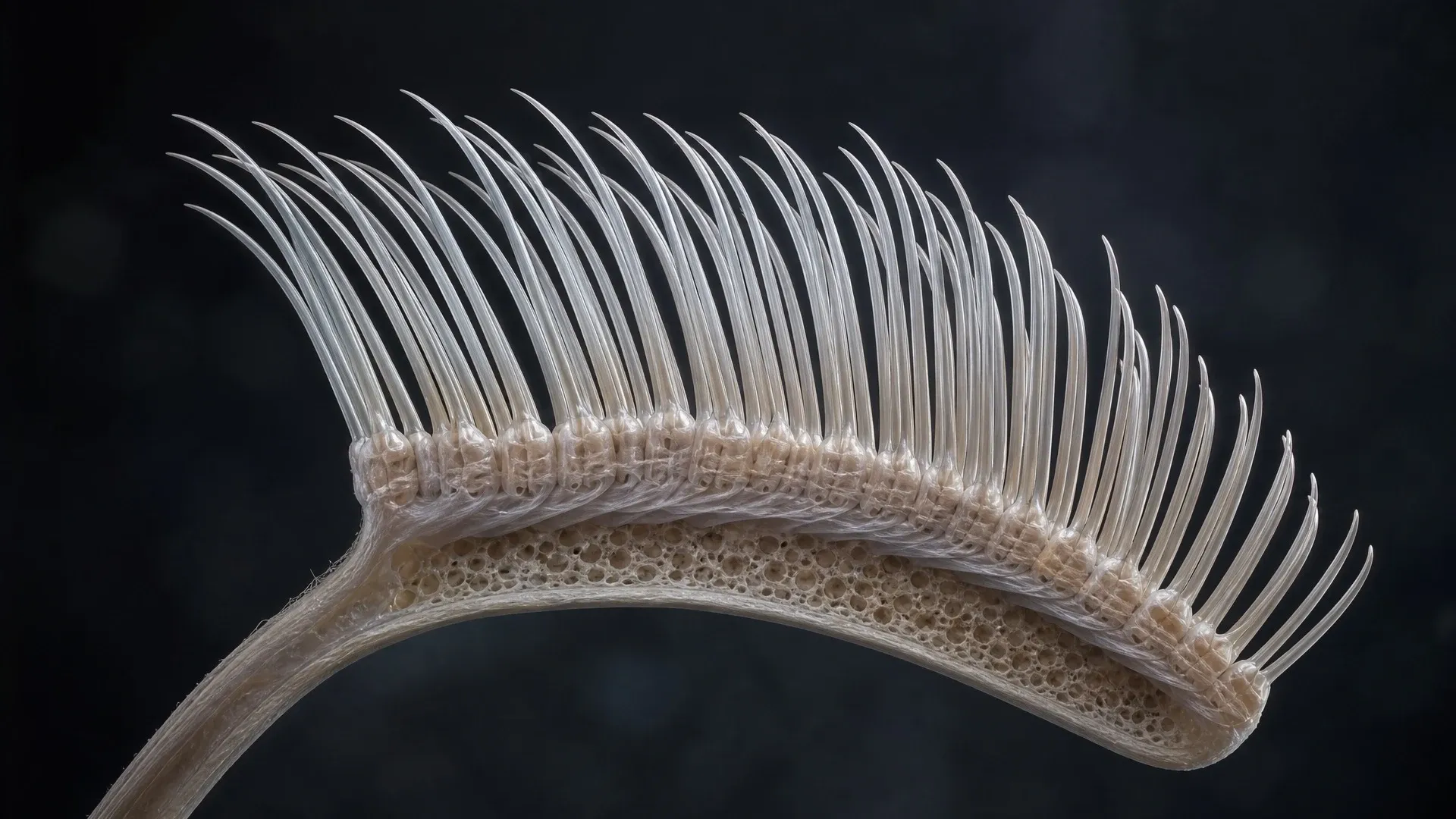
A toe pad divides contact across lamellae and microscopic setae instead of relying on one solid sticky surface.
A fingertip may appear to lie flat on glass, but under magnification it touches mainly at scattered high points. Skin has ridges, pores, oils, and other irregularities. The surface has its own microscopic texture. A stiff pad cannot follow all of those contours.
Gecko feet solve that contact problem by dividing it. Lamellae bend around relatively large changes in shape. Setae accommodate smaller ones. The finest tips settle over still smaller irregularities. Instead of asking one slab of material to lie perfectly flat, the foot creates a huge population of contacts that can adjust partly independently.
This is why “more surface area” is only half the explanation. What the animal gains is usable contact area: area that is genuinely close at the scale where molecular forces act.
Why weak molecular forces become strong enough
Electrical charge inside an atom or molecule is not perfectly static. Electrons move, so charge can become slightly uneven for an instant. That temporary imbalance can induce a corresponding imbalance nearby, producing a weak attraction known as a van der Waals force.
The force is not unique to geckos. It acts between your skin and a wall as well. The difficulty is distance: the attraction falls off rapidly as surfaces separate. Most of a human fingertip never gets close enough to make it useful.
A gecko’s spatulae do. One microscopic tip contributes almost nothing on the scale of the whole animal. But many tips approaching a surface together turn that ordinary molecular effect into a substantial total force. Experiments on individual setae and surfaces with different properties provided direct evidence that van der Waals attraction is central to this dry adhesive system.
Splitting contact into many small units also limits failure. A defect beneath one large adhesive pad could start a crack that propagates across the whole interface. When contact is distributed among separate setae, a poorly placed or contaminated region can fail while neighboring structures continue to carry load.
Grip depends on direction
Gecko setae do not project straight out like a new brush. They lean, and the spatulae at their ends have preferred orientations. When a gecko places a foot, it unfurls the toes and applies a small pull toward the body. This shear movement bends and aligns the setae, allowing more tips to settle into effective contact.
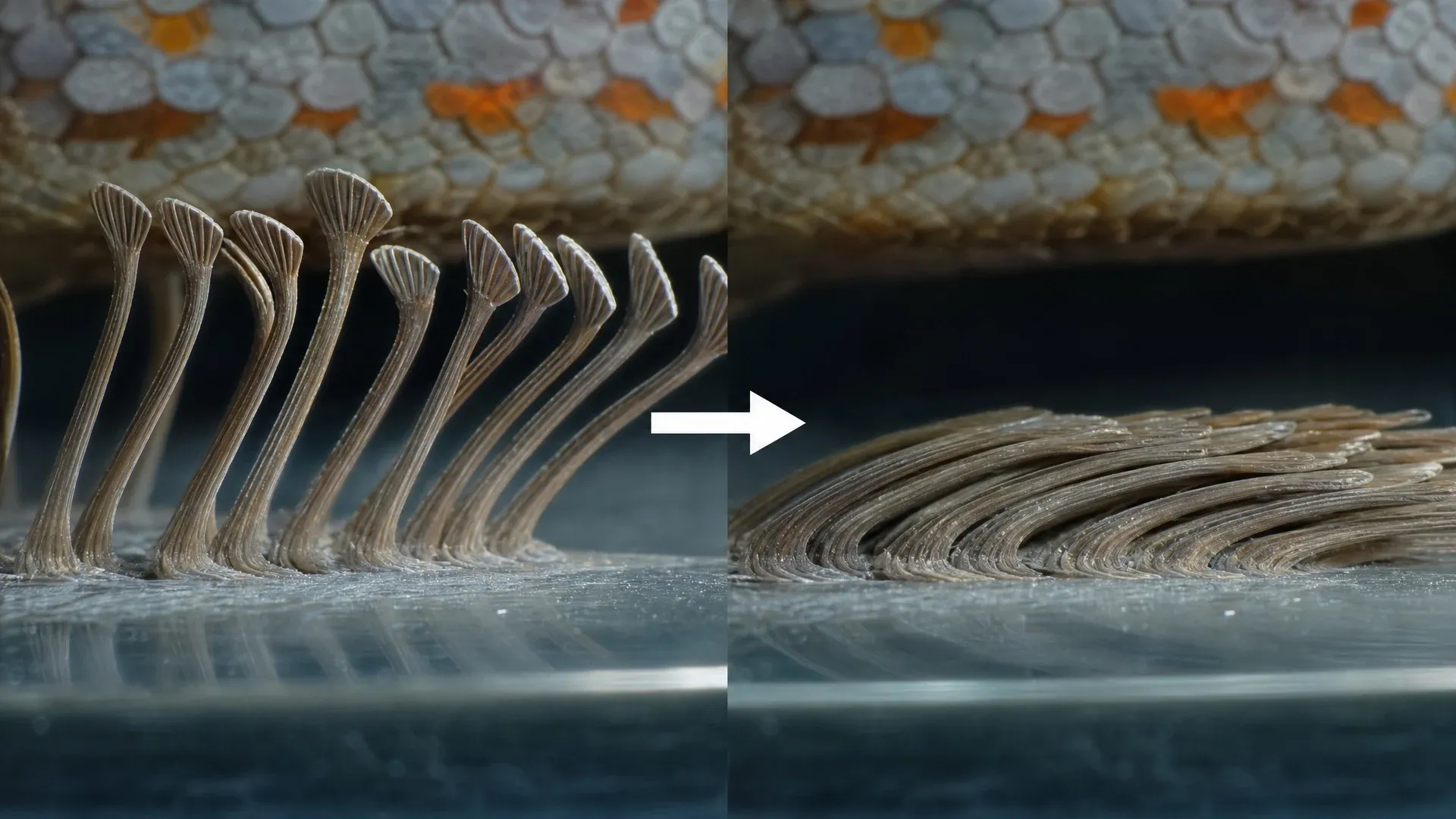
A small shear movement aligns the angled setae, bringing more of their terminal structures into close contact.
Pressing a foot down at an arbitrary angle therefore does not create the strongest attachment. The architecture has to be loaded in the direction where it works. On a ceiling, several feet can pull in opposing directions while their combined forces support the body.
This directional behavior explains why attachment is controllable rather than permanently sticky. The animal activates the geometry as part of each step.
Release works like peeling, not ripping
Pulling an entire foot straight away would ask a vast number of contacts to fail at roughly the same time. A gecko instead curls and hyperextends its toes, rolling each pad away from the surface.
The useful comparison is peeling tape from one edge rather than yanking it straight off a window. Gecko toes are not adhesive tape, but the geometry creates a similar advantage. Detachment is concentrated along a narrow moving boundary. As the toe angle changes, groups of setae reach orientations in which their grip drops sharply, and the spatulae release in sequence.
The result is not a compromise between strength and speed. The same angled, branching architecture supports both. Loaded in one direction, it produces strong contact; rolled in another, it releases progressively. Attachment and detachment can fit inside a continuous stride rather than becoming two slow, separate operations.
Glass is an excellent demonstration, not a universal test
Glass shows the system dramatically because claws have almost nothing to hook into, while the broad surface gives many spatulae an opportunity to approach closely. Outside a laboratory, geckos meet bark, stone, leaves, dirt, and rain. Flexible toes can wrap around larger features, and claws can add mechanical purchase on rough terrain.
The adhesive pads still have limits. Loose dust can stand between the spatulae and the underlying surface. Water can change the contact depending on what is wet and on the material involved. Roughness can help at one scale and disrupt contact at another. Studies of wet and rough substrates show why “sticks to everything” is too simple a description.
There is scientific fine print as well. Van der Waals attraction is central to the established explanation of gecko dry adhesion, but humidity and contact electrification can influence particular material pairings and conditions. Those effects refine the picture; they do not remove the need for the branching toe structure and extremely close contact.
What engineers have to copy
The obvious engineering goal is a reusable dry adhesive. Possible uses include climbing robots, delicate grippers, and devices that must hold firmly without leaving wet glue behind. But manufacturing small hairs is only the beginning.
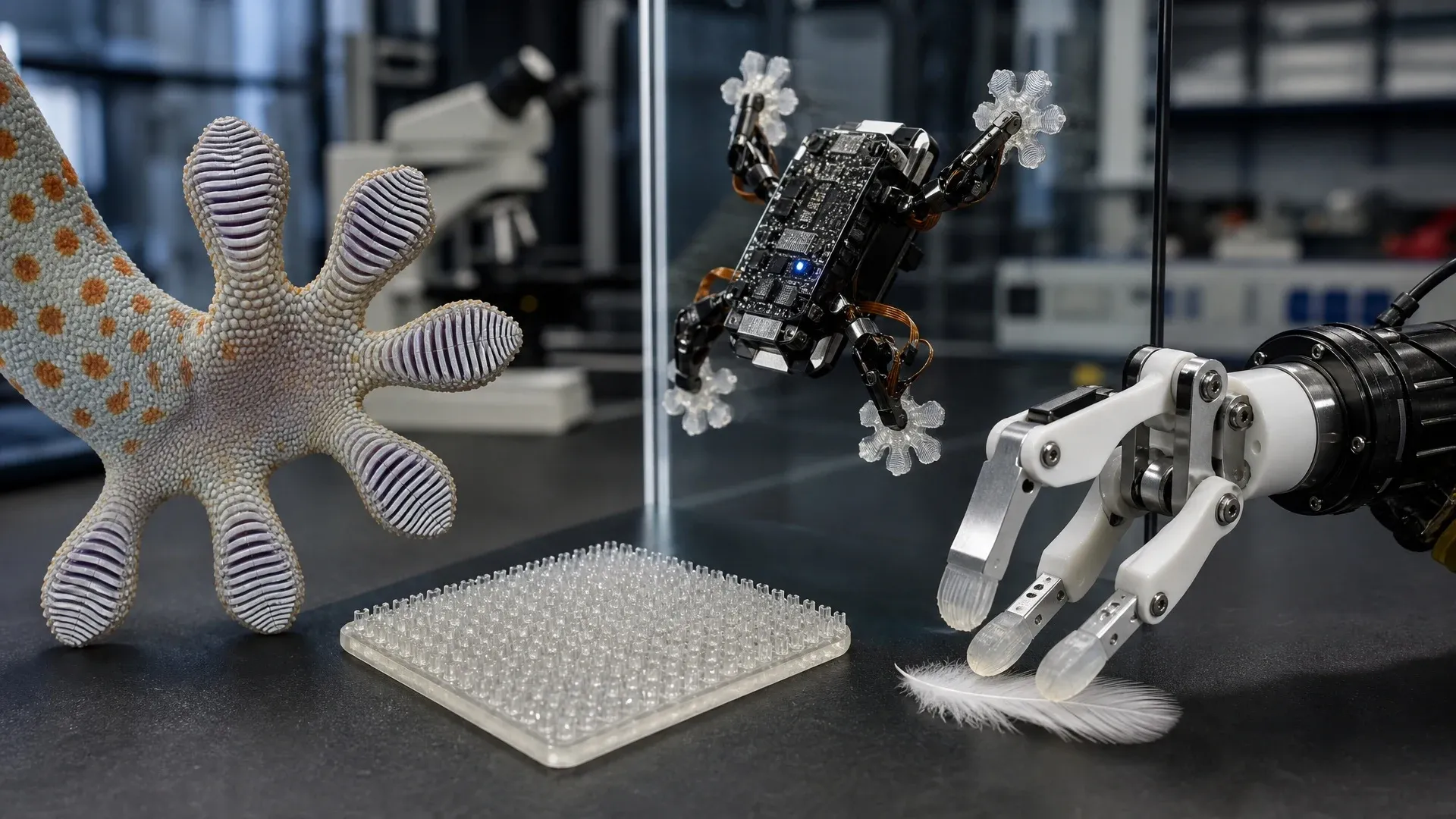
Gecko-inspired engineering must copy controlled attachment and rapid release, not merely manufacture tiny hairs.
An artificial system also has to reproduce flexibility across several scales, a large number of usable contacts, directional loading, durability, and reliable peeling. It must tolerate imperfect surfaces and repeated cycles. Natural setae perform those jobs as part of a living toe whose movement controls them automatically.
The gecko’s real trick is therefore not a mysterious substance. It is precise control of distance and direction. Millions of tips enter the tiny range where ordinary molecules attract; a pull organizes them into a load-bearing grip; and a rolling toe makes the contact disappear again.


