Short answer
The answer in plain English
A platypus detects the weak electric fields produced when prey nerves and muscles become active. Roughly 40,000 electroreceptors across its soft bill convert voltage changes in water into nerve signals. Nearby mechanoreceptors also detect pressure and movement. By sweeping its head and combining both patterns in the brain, the animal can locate prey at short range while its eyes, ears, and nostrils are closed.
Why it matters
What to understand
The platypus bill is a living sensory surface, not a duck-like scoop. Rows of electroreceptors register tiny biological fields, while push-rod mechanoreceptors register vibration and contact. The broad array and side-to-side search movement provide directional clues. Electroreception does not reveal distant animals or create a visual picture, but it is well matched to muddy riverbeds where sight and smell are poor guides.
Visual guide
How the pieces fit together


The bill replaces sight beneath the water
A diving platypus closes its eyes, nostrils, and ear openings. In a muddy river, that looks like a recipe for missing every meal. Yet the animal finds shrimp, worms, insect larvae, and other small prey hidden among gravel and sediment.
The broad bill is the reason. It is not a hard duck bill attached to a mammal. It is soft, flexible skin supplied by dense branches of the trigeminal nerve and covered with receptors for electricity, pressure, vibration, and touch. Underwater, it becomes the platypus’s primary map of the nearby world.
Living prey leaks tiny electrical clues
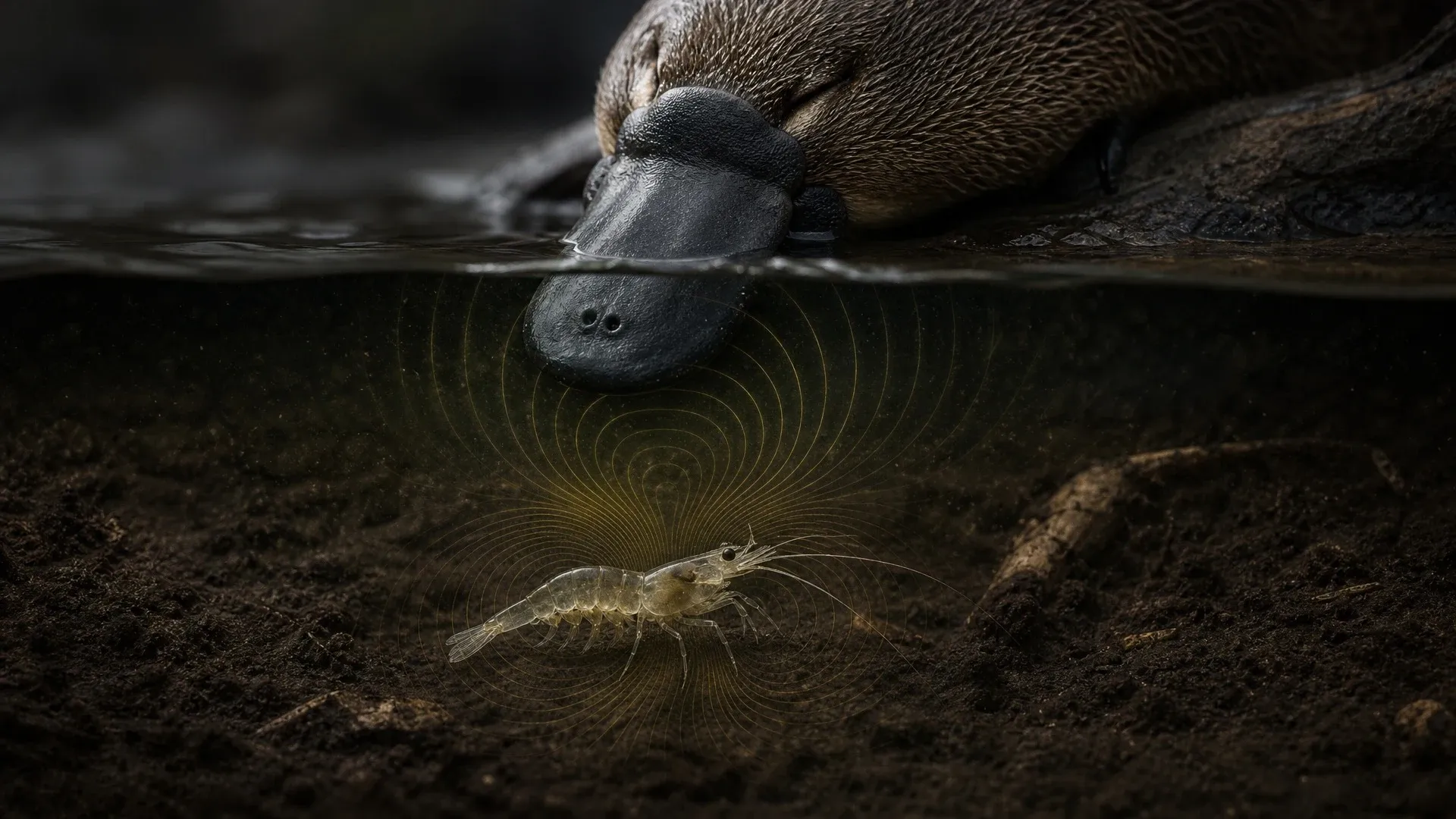
Nerves and muscles depend on the movement of charged particles across cell membranes. When a shrimp flicks its tail or a larva contracts, that activity produces a weak, changing electric field. Water conducts the signal well enough for a very sensitive detector to register it at short range.
The platypus does not generate a hunting field or shock its prey. It detects electricity already produced by another animal. Early experiments reported in Nature established electroreception in the platypus and helped explain how it could orient toward concealed sources.
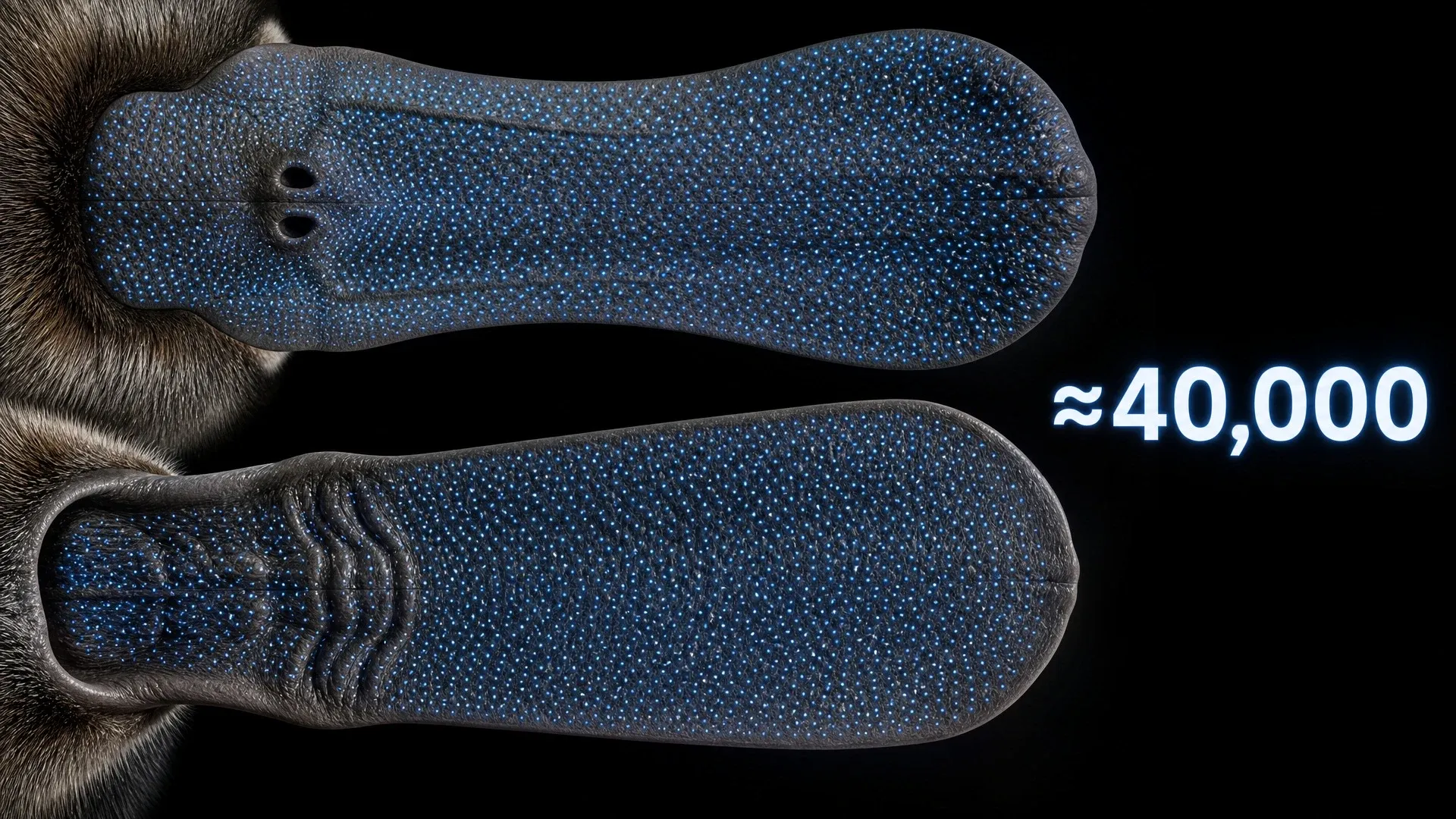
Researchers have described roughly 40,000 electroreceptors in the skin of the upper and lower bill. Many developed from specialized glands. Tiny surface openings lead toward sensory nerve endings; a voltage change alters their firing, converting an invisible field in water into a biological signal.
An array can reveal where the signal came from
One receptor can report a pulse but offers little direction. Thousands spread across a wide surface produce a pattern. A source near the left edge affects the array differently from one below or to the right. The receptors are arranged in bands across the bill, giving the brain many points to compare.
A foraging platypus also sweeps its head from side to side. This movement samples the field from changing positions. It works somewhat like turning your head to locate a faint sound: motion creates differences that the nervous system can use. The analogy is limited, because the animal is comparing activity across a bill rather than arrival times at two ears.
Direction is not the same as a precise long-range image. The field weakens quickly with distance, sediment can complicate it, and scientists cannot know what the sense feels like to the platypus. It may have no visual quality at all.
Electricity works together with touch
The bill also contains tens of thousands of mechanoreceptors, including specialized push-rod structures that respond to pressure, vibration, and contact. Moving prey creates both an electrical change and a disturbance in the surrounding water.
Studies of the sensory cortex find electrical and mechanical input represented in neighboring bands, with some neurons responding to both. This arrangement, reviewed in work on platypus sensory processing, shows that electroreception is part of a combined system rather than an isolated superpower.
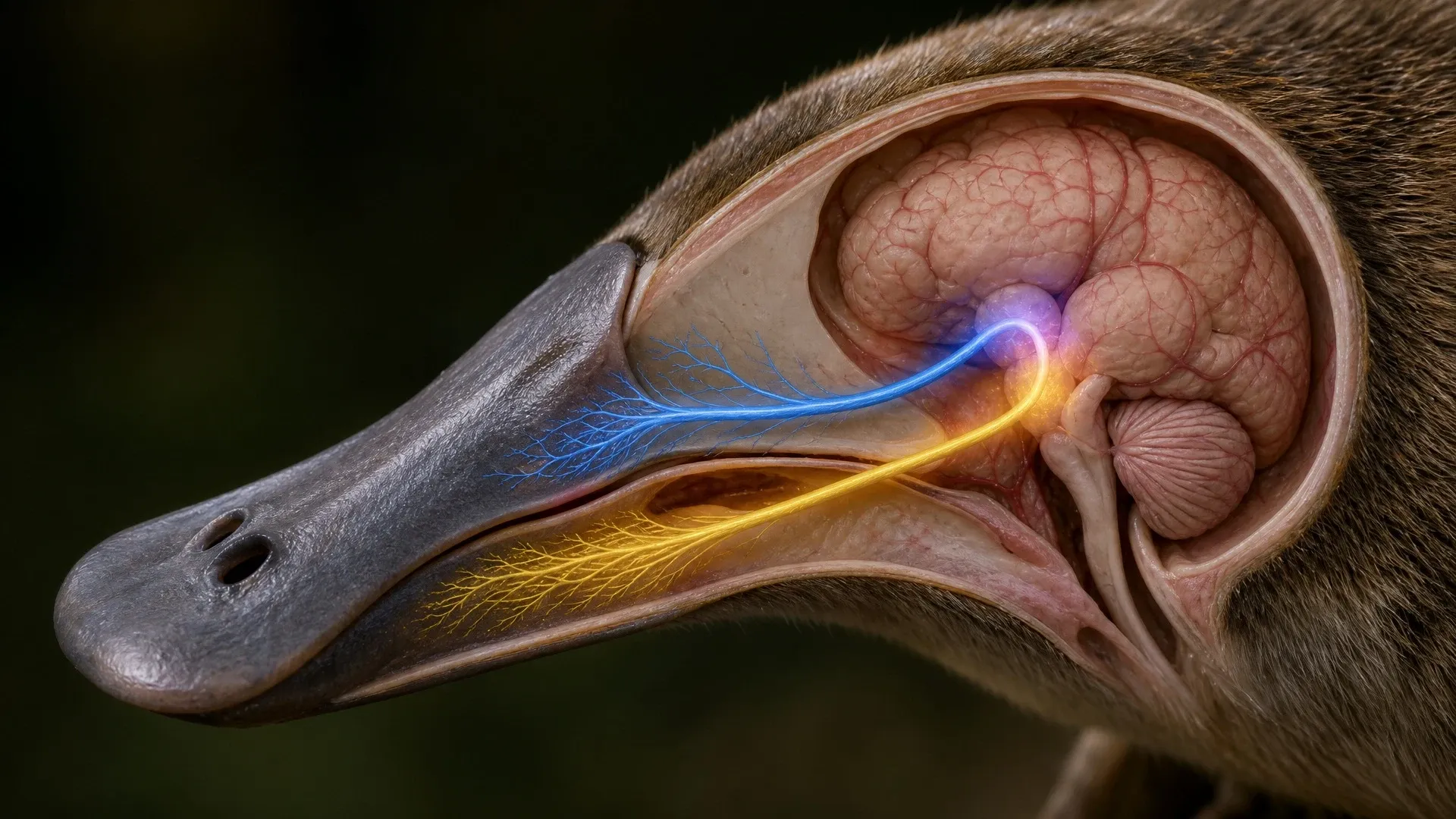
Researchers have proposed that timing could help estimate distance. An electrical change should reach the bill before the slower mechanical disturbance traveling through water. A delay between the signals could therefore carry range information. The idea is plausible, but the exact calculation used by a hunting platypus remains unresolved.
A hunt is an active scan
Near the bottom, the animal uses its front feet for propulsion while its hind feet and tail steer. The bill probes gravel and passes over soft sediment. A buried animal twitches; the receptor pattern changes; the platypus turns and closes the remaining distance.
Captured food and sediment enter the mouth, and useful items can be stored briefly in cheek pouches. Adult platypuses lack functional teeth, so they surface and grind the food between hardened plates.
Closing vulnerable openings is therefore not merely accepting blindness. It protects them from water and grit while switching to senses better matched to the job. Stained water, plants, disturbed mud, and buried prey make ordinary vision unreliable even if the eyes stayed open.
Electroreception evolved more than once
Sharks, rays, and several fishes also detect weak electric fields. Echidnas retain less elaborate electroreceptors, though their role in natural feeding is less clear. These systems are not all inherited from one electrically sensitive ancestor with the same organs. Evolution has repeatedly arrived at electroreception through different anatomical routes because electricity carries useful information in water.
The platypus’s apparently mismatched features make sense together. Webbed feet move a streamlined body through freshwater; dense fur insulates it; closable openings protect familiar senses; and an oversized sensory bill sweeps the habitat where its food hides. What looks absurd from above water is a coherent design for reading a riverbed without light.


