Short answer
The answer in plain English
The Chicxulub asteroid killed life near the impact through blast, heat, debris, earthquakes, and tsunami. Farther away, many organisms likely survived the first hours. The global killer was the aftermath: dust, soot, and sulfur-bearing material reduced sunlight, cooled the planet, disrupted photosynthesis, and collapsed food webs. Large non-avian dinosaurs could survive a shock wave yet still starve in the low-energy world that followed.
Why it matters
What to understand
The asteroid struck an unusually dangerous target of carbonate and sulfur-bearing rocks in a shallow sea. The collision excavated the Chicxulub crater, launched ejecta, and generated extreme waves and fires. Fine atmospheric material then suppressed light and primary production. Survival favored small bodies, flexible diets, sheltering behavior, dormancy, and food webs able to use stored detritus. Birds survived; every non-avian dinosaur lineage disappeared.
Visual guide
How the pieces fit together


Extinction took longer than the collision
The Chicxulub asteroid did not erase every non-avian dinosaur in one flash. Near the impact site, the blast was unsurvivable. On the opposite side of Earth, some animals may have endured the first hours. What made the event a global mass extinction was the chain that followed: rock altered the atmosphere, the atmosphere removed sunlight, and the loss of sunlight dismantled food webs.
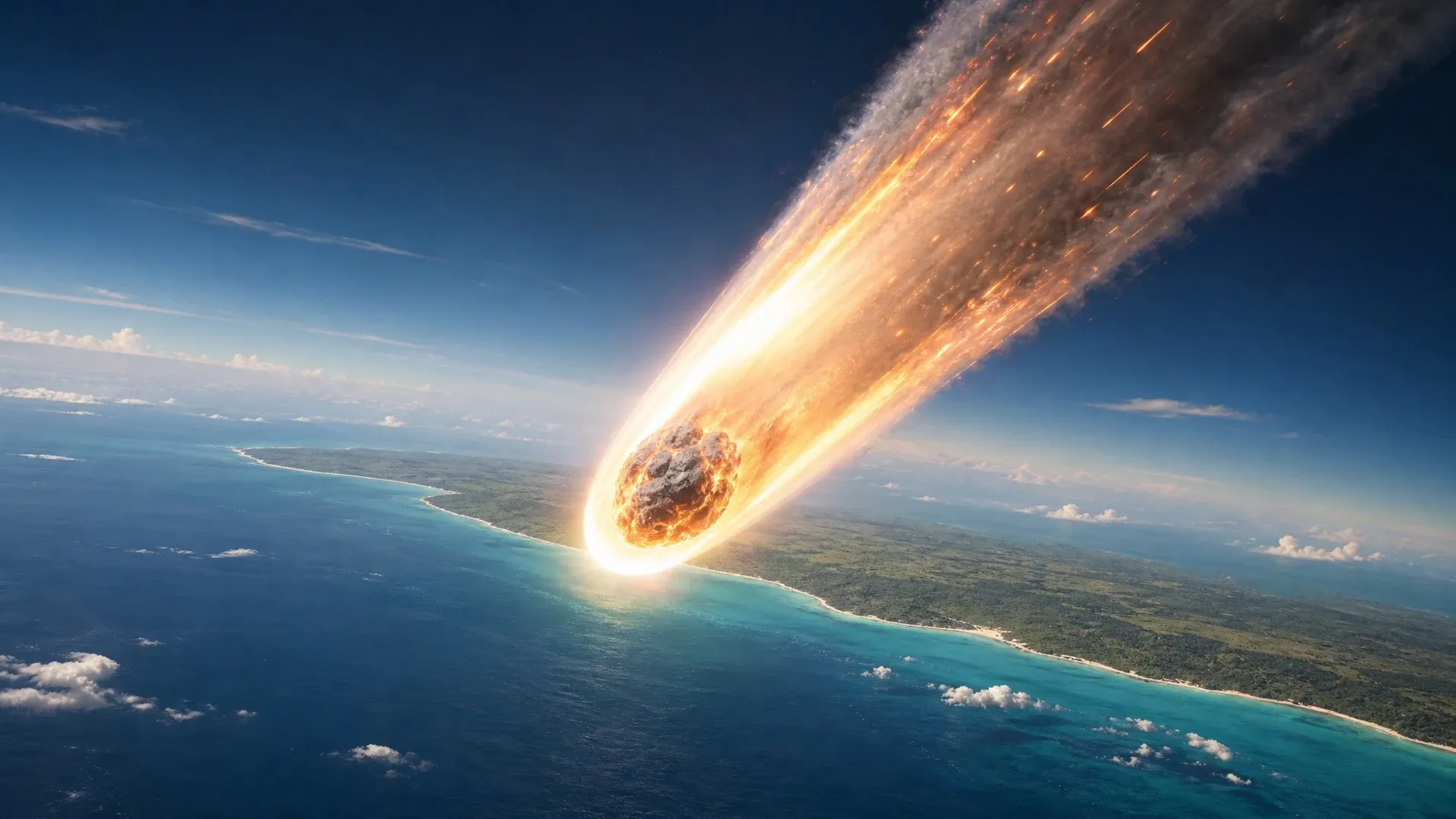
The impact happened about 66 million years ago in a shallow sea over what is now Mexico’s Yucatán Peninsula. The roughly 10-to-15-kilometer object approached at many kilometers per second and probably struck at a steep angle. Modeling of the impact trajectory indicates a geometry well suited to excavating and ejecting large amounts of target rock.
The target itself mattered. Carbonate and sulfur-bearing evaporite rocks supplied dust, carbon compounds, and sulfur-rich gases when vaporized. A comparably large asteroid hitting different geology would still be catastrophic, but its global climate effects could differ.
The first minutes remade a region
The collision released energy on the order of 10^23 joules. The impactor and target were compressed, melted, and vaporized. A temporary cavity opened and collapsed, leaving the buried crater roughly 180 kilometers wide. Thermal radiation, debris, extreme winds, and ground motion devastated the surrounding region.
Seawater rushed back into the crater. A drilled core through Chicxulub’s peak ring preserves around 130 meters of melt rock and broken debris deposited during the first day. The study titled The first day of the Cenozoic reconstructs a sequence of uplift, collapse, flooding, and sediment deposition measured in minutes and hours.
The displaced sea also created a tsunami unlike an ordinary coastal wave. Global modeling in AGU Advances found an initial energy thousands of times greater than the 2004 Indian Ocean tsunami, with waves crossing ocean basins and disturbing distant seafloors.
Ejecta carried evidence and heat around the planet
Material launched from the crater traveled on ballistic paths and returned through the atmosphere. Molten droplets cooled into glassy spherules. Shocked quartz and a layer enriched in iridium occur at the same geological boundary far from Mexico, tying widespread deposits to the impact.

Falling ejecta transferred heat to the atmosphere. How much thermal radiation reached different parts of the surface remains debated. Some models find shielding among particles; others allow a severe heat pulse and widespread fires. Charcoal and soot show that major burning occurred, but they do not establish one simultaneous global forest fire.
Location and shelter therefore shaped impact day. An animal close to Mexico faced blast, heat, debris, earthquakes, and water. Farther away, water, soil, rock, or simple distance might protect an organism from the first pulse. Survival that afternoon did not solve the longer crisis.
Darkness attacked the base of every food web
Fine silicate dust, soot, and sulfur-bearing material spread through the atmosphere. Large fragments returned quickly; microscopic particles could remain suspended. Researchers continue to refine the relative contribution of dust, soot, and sulfate aerosols, but the broad result is robust: the post-impact world became darker and colder.
A Nature Geoscience study used measured boundary-layer dust to model a years-long atmospheric residence and a severe reduction in light available for photosynthesis. Exact duration and intensity depend on assumptions. Plants and plankton did not require absolute darkness to fail; sustained light below useful levels was enough.
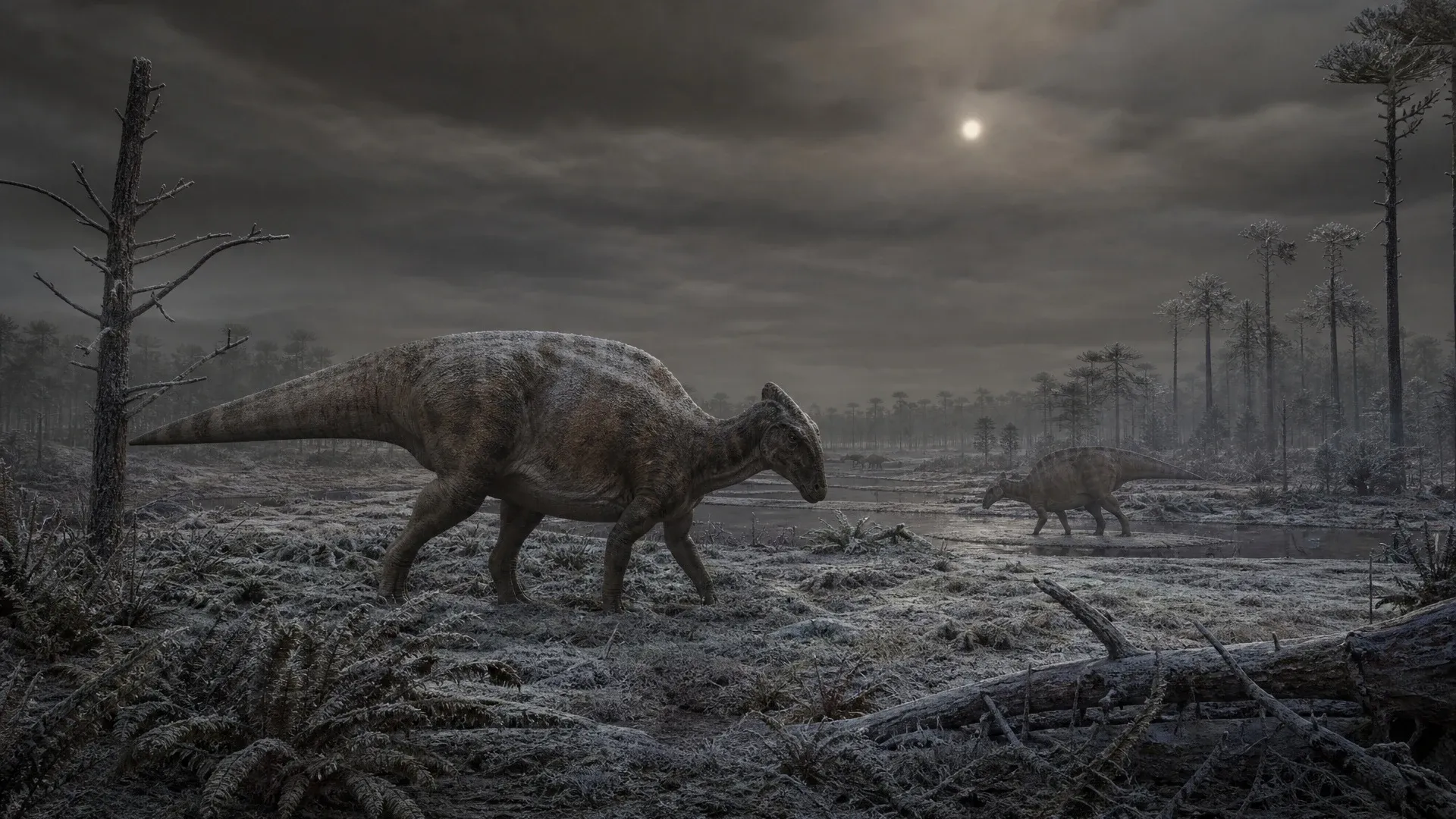
Large herbivorous dinosaurs needed continuous plant production. As vegetation declined, their energy supply disappeared. Carnivores then lost prey. In the oceans, reduced phytoplankton production removed energy from the base of marine food webs, while cooling and acidification added stress. Ammonites, large marine reptiles, and many plankton groups vanished.
Survival favored low demand and flexibility
Extinction was selective rather than random. Smaller animals required less food. Burrows and water offered protection from some immediate effects. Scavengers and generalists could use a wider menu; dormancy could postpone demand; seeds and stored detritus could support consumers when fresh production stopped.
Freshwater systems may have benefited from dead leaves, wood, and other organic material already stored in rivers and lakes. Crocodilians, turtles, amphibians, mammals, and some birds survived, though many species within those groups did not.
Those patterns should not be turned into a simple checklist of winners. A burrow only helps if its occupant survives long enough and later finds food. Small size lowers energy demand but also limits reserves. Aquatic shelter may blunt heat while leaving an animal exposed to acidification or a damaged food web. Survival emerged from combinations of place, timing, physiology, and available food—not from one universally protective adaptation.
The same caution applies to global averages. Climate models summarize worldwide changes, but animals experienced local coastlines, seasons, water bodies, fires, and food stores. Two populations with similar biology could face very different first weeks. The mass-extinction signal is global; the path to death or survival was always local.
Birds are the central correction to the phrase “the dinosaurs died out.” Birds are living dinosaurs. Every non-avian dinosaur lineage disappeared, but a small number of avian lineages crossed the boundary. Small size, ground-based habits, flexible diets, and access to seeds or detritus may have helped particular survivors; no single trait was a universal shield.
The asteroid was the cause, but not always the immediate instrument of death. Many dinosaurs may have survived the noise, heat, or falling debris only to encounter a world no longer producing enough food. Impact day killed a region in minutes and began a planetary ecological collapse that unfolded afterward.


