Short answer
The answer in plain English
The real Velociraptor was a roughly 1.5-to-2-metre-long, feathered predator from Late Cretaceous Mongolia, with much of that length in its tail and a body mass often estimated around 10–20 kilograms. Its raised sickle claw was likely useful for puncturing and gripping prey, not the movie-style sweeping slash.
Why it matters
What to understand
Jurassic Park's “raptor” borrowed heavily from the larger Deinonychus, enlarged it again, and gave it Velociraptor's name. Fossils instead show a compact desert animal with inward-facing hands, a balancing tail, and direct evidence for long arm feathers. Biomechanical studies and the Fighting Dinosaurs fossil fit close grappling better than a disemboweling kick, while claims about coordinated pack hunting remain unproven.
Visual guide
How the pieces fit together


The famous movie raptor is a composite
The real Velociraptor mongoliensis was not a human-sized reptile stalking a tropical kitchen. It was a compact, feathered predator from an arid part of Late Cretaceous Mongolia. Its back would have stood below an adult human’s waist, much of its roughly 1.5-to-2-metre length was tail, and mass estimates often fall around 10–20 kilograms.
The cinematic animal began with a different dinosaur. Deinonychus, described by John Ostrom in 1969, was a larger North American relative with the horizontal body, elevated tail, grasping hands, and enlarged second-toe claw that transformed public ideas about active dinosaurs. Michael Crichton consulted Ostrom while writing Jurassic Park but preferred the name Velociraptor. The screen version was then made larger again.
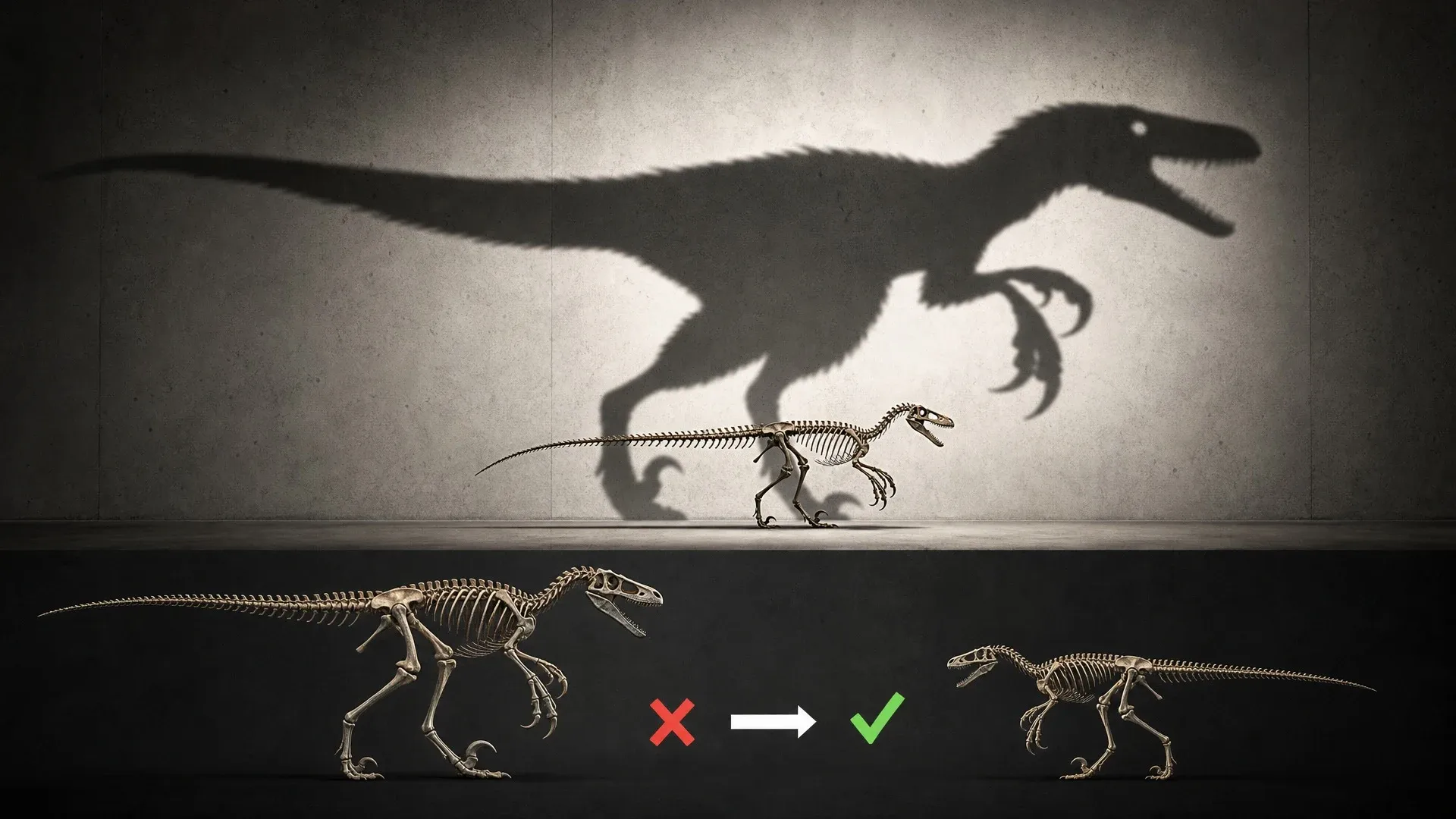
The film animal borrowed the larger Deinonychus body plan and enlarged it again; the real Velociraptor was much smaller.
The name is not the only temporal mismatch. Both Velociraptor and Deinonychus lived during the Cretaceous, not the Jurassic. The real animal’s fossils come from the Djadokhta Formation, around 75 million years old, in what is now Mongolia.
A desert predator built around balance
The Djadokhta landscape was dominated by windblown sand, dunes, sandy flats, and temporary water—not dense jungle. Velociraptor shared it with the horned Protoceratops, armored Pinacosaurus, oviraptorosaurs, mammals, lizards, and early birds. Sudden burial in shifting sand helped preserve some of the formation’s exceptional skeletons.
A real Velociraptor had a low, elongated skull lined with sharp, recurved teeth. Its arms were long and its hands faced inward, as though holding a large ball. The palms-down pose in older art would require a rotation its wrists could not make. A long tail, stiffened by elongated bony structures and tendons, was held clear of the ground and helped control balance during turns and struggles.
This anatomy produces an animal that looks athletic without resembling the film monster. It is lower, lighter, narrower, and more birdlike. That last word is not an analogy added for style; feathers are directly supported by fossil evidence.
Quill knobs put feathers on the arms
In 2007, researchers described a Velociraptor ulna—the larger forearm bone—with a row of evenly spaced bumps. Living birds have comparable quill knobs where ligaments anchor the shafts of large wing feathers. The fossil therefore shows that long, complex feathers attached along the back of the arm.
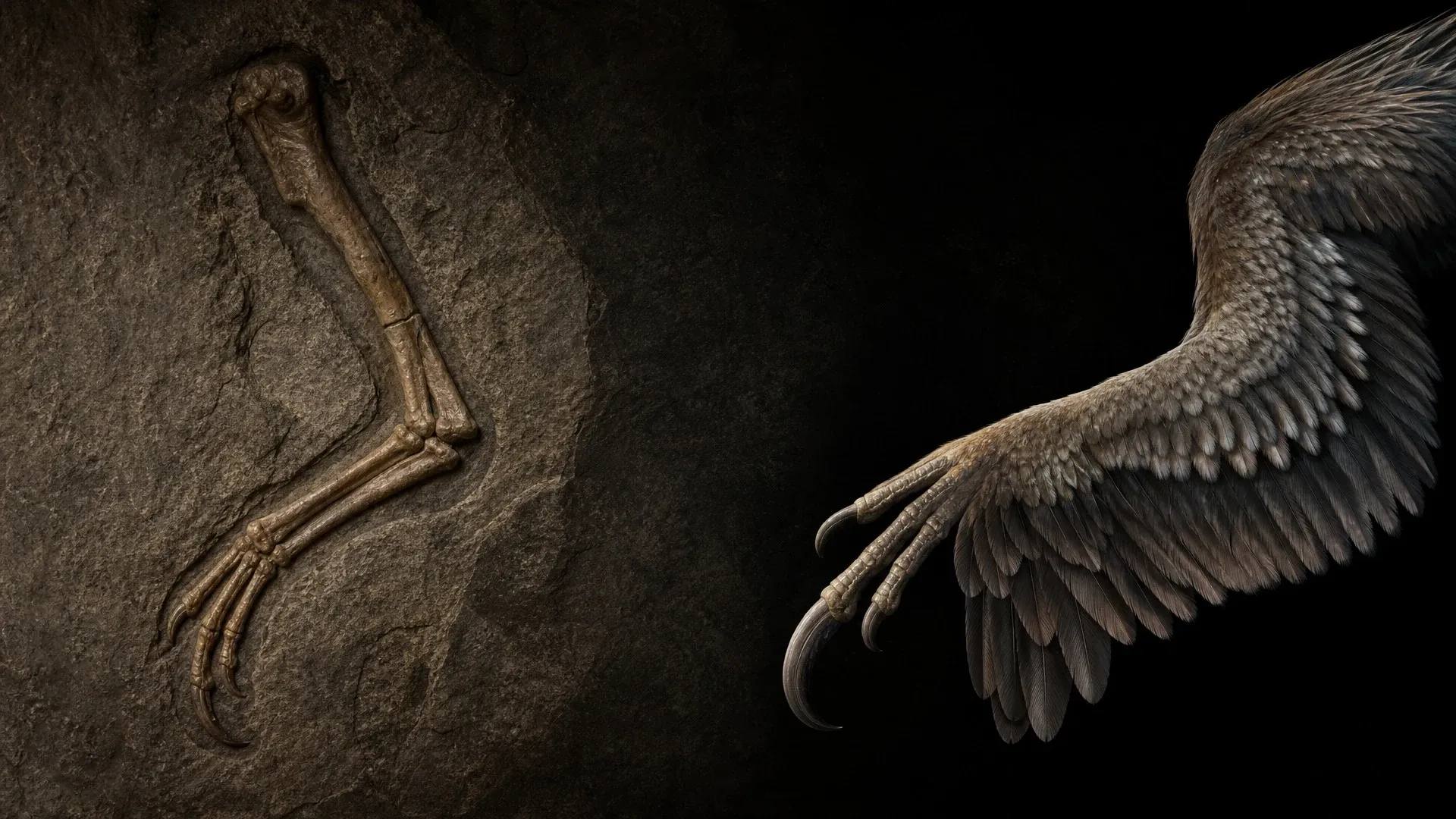
Evenly spaced bumps on a Velociraptor ulna match attachment points for large feathers in living birds.
Velociraptor was too large and lacked the full anatomy needed for powered flight. Its arm feathers may have been retained from smaller ancestors and used for display, egg shielding, balance, or some combination of functions. The fossil does not tell us the precise color or arrangement of every feather. Close relatives preserved with extensive plumage nevertheless make a broadly feathered body the defensible reconstruction.
The result is not simply a lizard with fuzz pasted onto it. Arm feathers alter the outline into wing-like surfaces, the tail likely carried feathering, and the hands sit beneath that plumage. Strip away the movie skin and a predatory bird with teeth and a long bony tail begins to emerge.
The sickle claw was probably a grappling tool
The enlarged claw on the second toe remains the animal’s most recognizable weapon. Its toe could lift high enough to keep the claw off the ground during ordinary walking, protecting the point. A keratin sheath would have extended the bony core, making the living claw larger than a bare fossil suggests.
What it did is less cinematic than the traditional answer. A strongly curved claw is not automatically an efficient knife. Experiments and biomechanical models question whether dromaeosaur claws could make long, deep slashes through skin and muscle. Their form is better suited to puncturing, hooking, and holding.
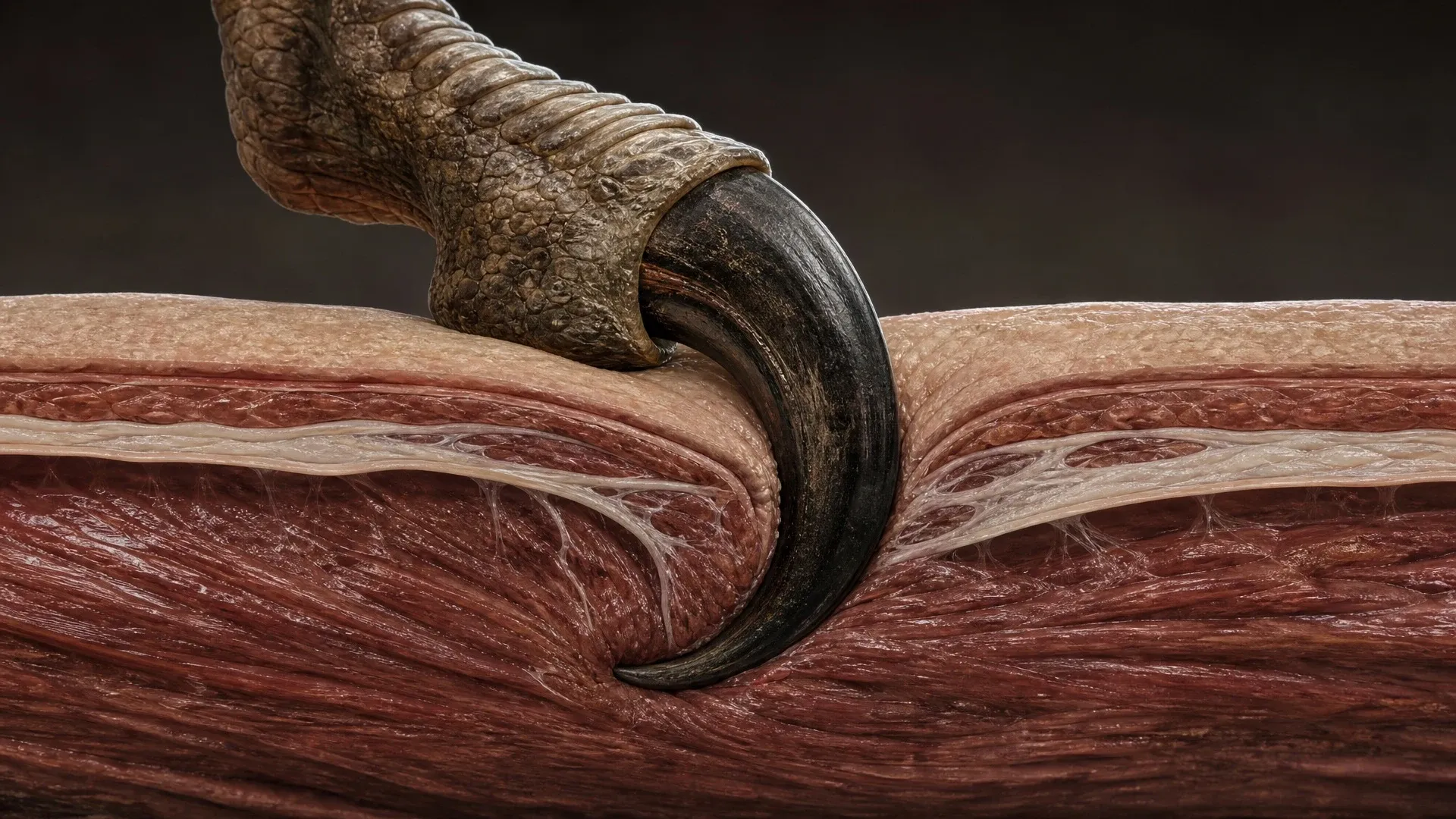
The claw’s curvature is better suited to puncturing and maintaining a grip than to making one long knife-like cut.
One model compares the feet with those of hawks and eagles. A bird of prey lands on an animal, drives in its talons, and pins it beneath its weight. A dromaeosaur may likewise have gripped prey with both feet while balancing with its tail and feathered arms. Musculoskeletal modelling of Deinonychus also supports grasping and restraining. None of this proves that every species used the claw identically, or that stabbing and cutting never happened. It replaces one guaranteed movie move with a range of mechanically plausible actions.
One fossil captures the danger of close combat
The Fighting Dinosaurs specimen gives the idea of grappling an extraordinary fossil context. A Velociraptor mongoliensis and Protoceratops andrewsi are preserved tangled together. The herbivore’s beak traps the predator’s right arm, while one enlarged foot claw lies around the Protoceratops neck region.
We cannot replay the start of the encounter. It may have been an attack, a defense around food or a nest, or another confrontation before collapsing sediment buried both animals. Yet the fossil shows close contact with dangerous prey. The sickle claw is engaged in a struggle, not frozen at the end of a wide slashing kick.
Other evidence argues against treating Velociraptor as a machine programmed only for live kills. Tooth marks and shed teeth near Protoceratops remains indicate feeding on a carcass, while another specimen preserved a pterosaur bone in its gut. Modern predators hunt and scavenge when opportunities arise; the categories are not opposites.
Capable does not mean humanlike
Velociraptor had a relatively large brain for a non-avian dinosaur of its size. Reconstructions of its braincase and inner ear suggest useful hearing and good balance for tracking moving prey. That supports an alert, active hunter. It does not support opening doors, setting traps, or coordinating military-style attacks.
Organized pack hunting is similarly unproven for Velociraptor mongoliensis. Several animals can gather at a carcass or tolerate one another without forming a stable cooperative hunting group. Social behavior remains possible, but the fossil record does not turn possibility into a movie pack.
The films did get one large idea right: these were energetic animals with horizontal bodies, elevated tails, and a deep evolutionary connection to birds. The real Velociraptor is smaller than its screen namesake but not less interesting. Its quill knobs, inward-facing hands, specialized feet, and fossilized fight reveal a predator shaped for balance and close control. Its closest living echoes are not giant lizards. They are feathered hunters gripping prey beneath curved talons today.


